Double Angular Collets: When Standard Collets Fall Short in Complex Machining
- nazmakhatoon1057
- 2 days ago
- 4 min read
A slight vibration here, a tiny loss of accuracy there, and before long the whole production quality starts to feel inconsistent. That’s often where standard collets reach their limit.
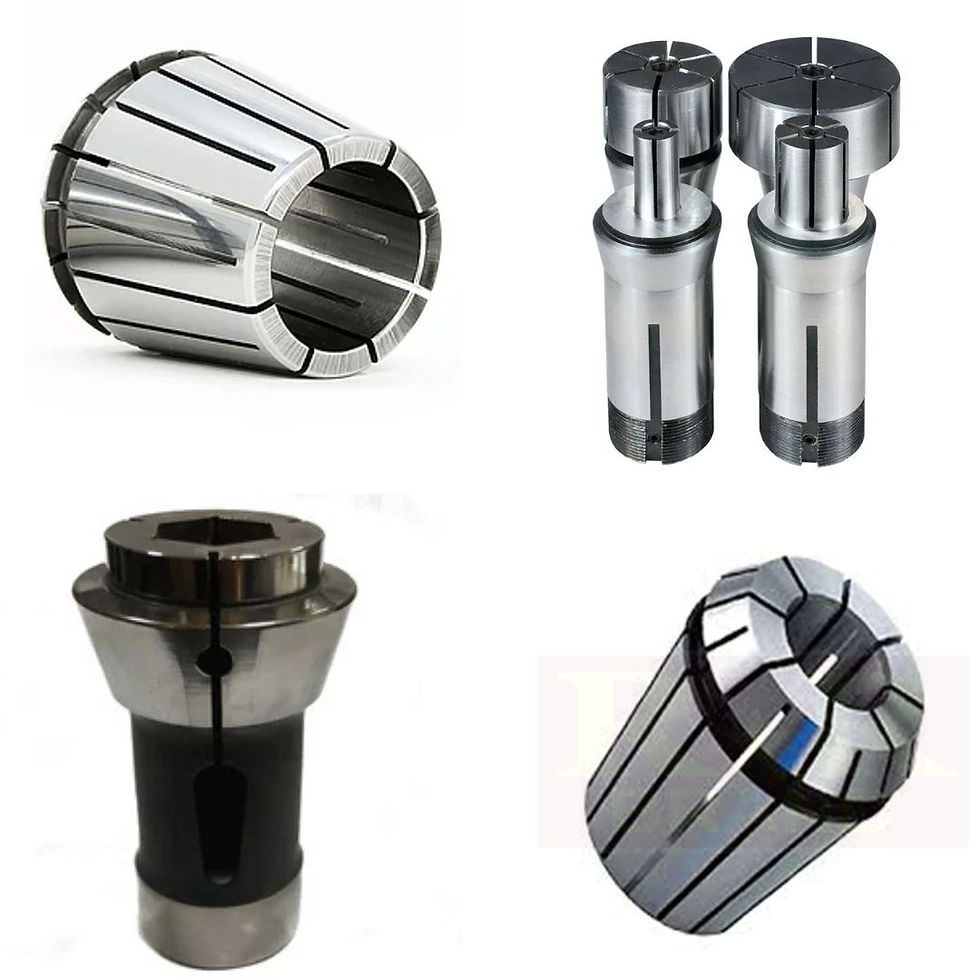
As machines get faster, tolerances get tighter, and production runs get longer, traditional workholding systems like basic collets, ER collets, or even DIN 6343 collets start showing strain. This is exactly the gap that double angular collets are designed to fill.
Where Standard Collets Begin to Struggle
On paper, standard collets are reliable. In everyday machining, they work just fine. But real shop-floor conditions are rarely “ideal.”
Issues usually start appearing when:
Spindle speeds increase beyond comfortable limits
Heavy cutting forces create uneven stress
Workpieces are long, thin, or irregular
Multi-spindle machines run continuous cycles
At that point, even small instability turns into visible problems—poor surface finish, tool chatter, or slight dimensional variation.
Collet systems like ER collets, Traub collets, and DIN collets are widely used because they’re flexible and easy to work with. But they are not always built for extreme load conditions or very high-precision repetitive production.
What Makes Double Angular Collets Different
Double angular collets are not just a variation—they are more like a rethinking of how gripping should work.
Instead of relying on a single taper to hold the workpiece, they use two angular contact surfaces. This might sound like a small design change, but in machining, it makes a big difference.
What this actually does in real operation:
The grip becomes more balanced across the surface
The workpiece stays centered even under heavy load
Vibration reduces noticeably during cutting
Slippage becomes far less likely
In simple terms, the collet doesn’t just “hold” the part—it stabilizes it.
When You Notice Standard Collets Are Not Enough
Most manufacturers don’t switch immediately. They usually notice patterns first:
Tools wear out faster than expected
Slight variation appears in batch production
Machines need more frequent calibration
Surface finish starts looking inconsistent
This is typically when engineers start exploring upgraded solutions instead of relying on general-purpose tooling.
Even precision-focused options like A-25 collets, A-42 collets, and 161E collets can only go so far when machining conditions become aggressive or highly repetitive.
The Role of Quality Manufacturing
A collet is a small component, but its manufacturing precision decides everything.
Good collets depend on:
Perfectly ground angular surfaces
Proper heat treatment for hardness and flexibility
Tight tolerance control during production
Smooth surface finishing to reduce wear
This is why experienced Collet manufacturers play such an important role in machining industries. The difference between average and high-precision collets is often felt directly on the production floor, not just in specifications.
A reliable collet manufacturer in India also ensures availability, customization, and support for different machining setups, which becomes important for long-term production planning.
Performance in Traub and Multi-Spindle Machines
Machines like those using Traub collets are designed for high-volume production. They run fast, continuously, and often under heavy load.
This is exactly where stability matters the most.
When standard collets are used in such systems, small inaccuracies multiply quickly over thousands of cycles. Double angular collets help reduce that drift by keeping grip force consistent throughout the machining process.
The result is:
More stable output across long production runs
Less rejection due to dimensional errors
Better overall machine efficiency
Compatibility with Standard Systems
One of the biggest advantages is that double angular collets don’t force you to redesign your entire setup.
They work alongside existing systems like:
DIN-based tooling setups
Standard CNC collet chucks
ISO-based machining configurations
For example, widely used systems like DIN 6343 collets are still the backbone of many workshops. Double angular designs simply enhance what’s already there instead of replacing everything.
ER Collets vs Double Angular Designs
ER collets are popular for a reason—they’re flexible, cost-effective, and widely available. But they are general-purpose tools.
When compared:
ER collets → good for everyday machining
Double angular collets → built for precision under pressure
So it’s not about replacing ER systems completely. It’s about choosing the right tool when the job becomes more demanding than usual.
Better Stability at High Speed
High RPM machining introduces a problem most people underestimate: centrifugal force.
As speed increases, the collet naturally wants to expand slightly. Even a tiny movement can affect precision.
Double angular collets handle this better because:
They maintain more consistent radial grip
They resist micro-movement during rotation
They reduce vibration at the cutting edge
This is especially useful in aerospace, automotive, and hydraulic component manufacturing, where consistency is critical.
Common Collet Types in the Industry
Different setups use different collets depending on the machine and application:
A-25 collets – compact precision setups
A-42 collets – medium-duty machining
161E collets – specialized lathe systems
DIN 6343 collets – standardized industrial applications
Double angular collets don’t replace these—they enhance performance when conditions become more demanding.
Why More Manufacturers Are Upgrading
The shift toward automation and high-speed machining has changed expectations. Downtime is expensive, and inconsistency is unacceptable.
That’s why many manufacturers are moving toward advanced gripping solutions like double angular collets. The benefits are practical, not theoretical:
Fewer production interruptions
More predictable machining results
Longer tool life
Reduced maintenance stress on machines
In simple terms, it’s about keeping production steady when everything else is running fast.
Final Thoughts
Machining today is less about just cutting metal and more about controlling precision under pressure. Standard collets still have their place, but they are no longer enough for every situation.
Double angular collets step in where stability, accuracy, and consistency matter the most. They don’t replace traditional systems—they extend their capability.

Comments