Why Collet Geometry Matters in High-Speed Machining
High-speed machining has made modern manufacturing faster and more productive. CNC machines can now operate at very high spindle speeds, remove material quickly, and produce components with tight tolerances. But as machining speeds increase, even small problems in the tooling setup can become serious.
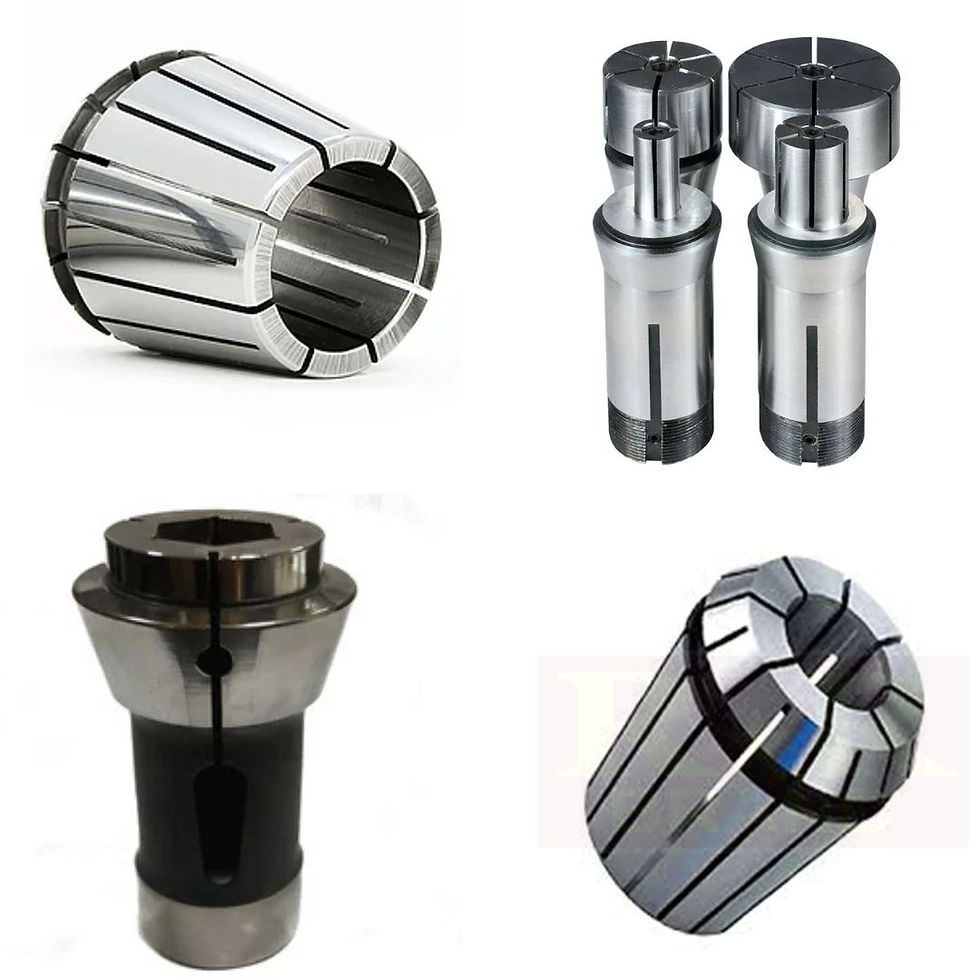
One component that often gets overlooked is the collet.
A collet does much more than simply hold a cutting tool or workpiece. Its geometry has a direct effect on gripping, concentricity, vibration, tool life, and machining accuracy. The taper, slots, gripping bore, wall thickness, and overall shape all influence how the collet behaves when the spindle is rotating at high speed.
Understanding this relationship can help machine operators and manufacturers make better tooling decisions.
What Is Collet Geometry?
Collet geometry simply refers to the shape, design, and dimensions of a collet. This includes features such as the taper, internal bore, gripping area, slots, nose profile, length, and wall thickness.
These details may seem small, but they determine how the collet fits into the chuck and how it grips the tool or workpiece.
At lower spindle speeds, a minor imperfection may not immediately cause noticeable problems. At high speeds, the same imperfection can lead to vibration, runout, uneven tool wear, and reduced machining accuracy.
That is why precision matters at every stage of collet design and manufacturing.
Taper Geometry and Proper Seating
The taper is one of the most important parts of a collet. It allows the collet to seat correctly inside the matching collet chuck and helps convert the axial tightening force into radial gripping force.
When the taper is accurately manufactured, the collet can sit evenly in the chuck. This creates more consistent contact and helps keep the tool properly aligned.
A damaged, worn, or incorrectly sized taper can cause the collet to seat unevenly. This may result in excessive runout, poor gripping, vibration, or inconsistent machining.
Reliable Collet manufacturers therefore pay close attention to taper dimensions, grinding accuracy, and surface finish during production.
How Slot Design Affects Gripping
The slots running through a collet allow it to flex and contract around the tool or workpiece. Their design has a direct influence on how evenly the gripping force is distributed.
A properly designed slot pattern allows the collet to grip the tool securely without creating unnecessary pressure points. Damaged, cracked, or deformed slots can have the opposite effect.
This becomes even more important during high-speed machining because uneven gripping can contribute to vibration and tool movement.
For example, Er collets are designed to provide a useful gripping range while maintaining reliable tool holding. Their performance depends heavily on the accuracy of the bore, slots, taper, and other geometric features.
Why Balance Becomes Important at High RPM
When a collet rotates at high speed, balance becomes a major consideration.
Any rotating component with uneven mass distribution can generate centrifugal forces. At higher RPM, even a relatively small imbalance can create noticeable vibration.
Poor balance may lead to:
Increased spindle vibration
Poor surface finish
Uneven cutting
Faster tool wear
Additional spindle loads
Noise during operation
Reduced machining consistency
A well-made collet has a carefully controlled geometry that helps it rotate smoothly around the spindle axis.
This is particularly important for operations involving high spindle speeds, small cutting tools, precision finishing, and long machining cycles.
Collet Geometry and Tool Runout
Runout is one of the biggest concerns in precision machining. It occurs when the cutting tool does not rotate perfectly around the intended centerline.
Even a small amount of runout can cause one part of the cutting edge to do more work than the others. Over time, this can result in uneven tool wear, poor surface finish, and dimensional variation.
Accurate collet geometry helps minimize these issues by keeping the tool properly positioned within the holder.
For applications involving specific machine-tool requirements, Traub collets can be selected according to the relevant machine and tooling specifications. Correct fit and geometry are important for maintaining reliable tool positioning.
The Effect of Heat on Collet Performance
High-speed machining naturally produces heat. Cutting forces, friction, spindle rotation, and the machining environment can all contribute to temperature changes.
As the temperature changes, the collet and other tooling components can expand. Even a small amount of thermal expansion can influence gripping and tool position in precision applications.
Good collet design takes thermal behavior into account. The geometry, material, and manufacturing process all play a role in maintaining stable performance during demanding machining operations.
This is another reason not to choose a collet based solely on its basic dimensions.
Different Collets Have Different Geometries
Not every machining application requires the same type of collet. Different machines, workpieces, tools, and production requirements call for different designs.
For example, A-25 Collets and A-42 Collets are designed for specific applications and equipment. 161E Collets are also manufactured to meet particular machine and tooling requirements.
Similarly, DIN 6343 Collets follow a recognized dimensional standard, making correct sizing and compatibility important for proper installation and performance.
Using the correct collet geometry helps ensure that the component works as intended with the machine and chuck.
Why Manufacturing Accuracy Matters
The performance of a collet ultimately depends on how accurately it has been manufactured.
Small variations in the taper, bore, slots, or gripping surface can affect the way the collet seats and holds a tool. Factors such as material selection, heat treatment, grinding, dimensional control, and final inspection all contribute to the finished product.
An experienced collet manufacturer in India can help machining companies source collets made to consistent specifications for their particular applications.
Quality inspection is equally important. A collet may appear fine visually but still have dimensional errors that affect runout or gripping performance.
The Collet Is Part of a Larger System
It is easy to think of a collet as an individual component, but it actually works as part of a complete tooling system.
The collet, chuck, spindle, cutting tool, and workpiece all need to work together correctly.
For example, a high-quality collet may still perform poorly if chips or dirt are trapped between the mating surfaces. An incompatible chuck can also prevent the collet from seating correctly.
This means that selecting Collets for high-speed machining requires more than simply checking the diameter. Compatibility, operating speed, machine requirements, and application should all be considered.
Tips for Choosing Collets for High-Speed Machining
A few simple checks can help improve high-speed machining performance:
Check compatibility: Make sure the collet matches the chuck and machine.
Inspect the taper: Keep the taper clean and check it for damage or unusual wear.
Use the correct gripping range: Do not force a collet to hold a diameter outside its intended range.
Inspect the slots: Look for cracks, burrs, deformation, or signs of fatigue.
Check runout: Use suitable measuring equipment when tight tolerances are required.
Consider spindle speed: Select tooling that is appropriate for the intended RPM.
Keep everything clean: Chips, dirt, and coolant residue can affect proper seating.
Replace worn collets: A worn collet can affect tool life, accuracy, and machining stability.
Conclusion
Collet geometry may not always be the first thing considered when setting up a CNC machine, but it has a significant effect on high-speed machining performance.
The taper, slots, gripping bore, wall thickness, balance, and overall shape all influence how effectively a collet holds and positions a tool. When these features are manufactured accurately and matched correctly to the machine, they can help reduce vibration, control runout, improve tool life, and maintain machining accuracy.
High-speed machining leaves very little room for tooling errors. Choosing the right collet and keeping it in good condition can therefore make a noticeable difference to the entire machining process.
For manufacturers and machine shops, investing attention in collet geometry is not just about improving one small component. It is about creating a more stable, predictable, and reliable machining setup.

Comments